
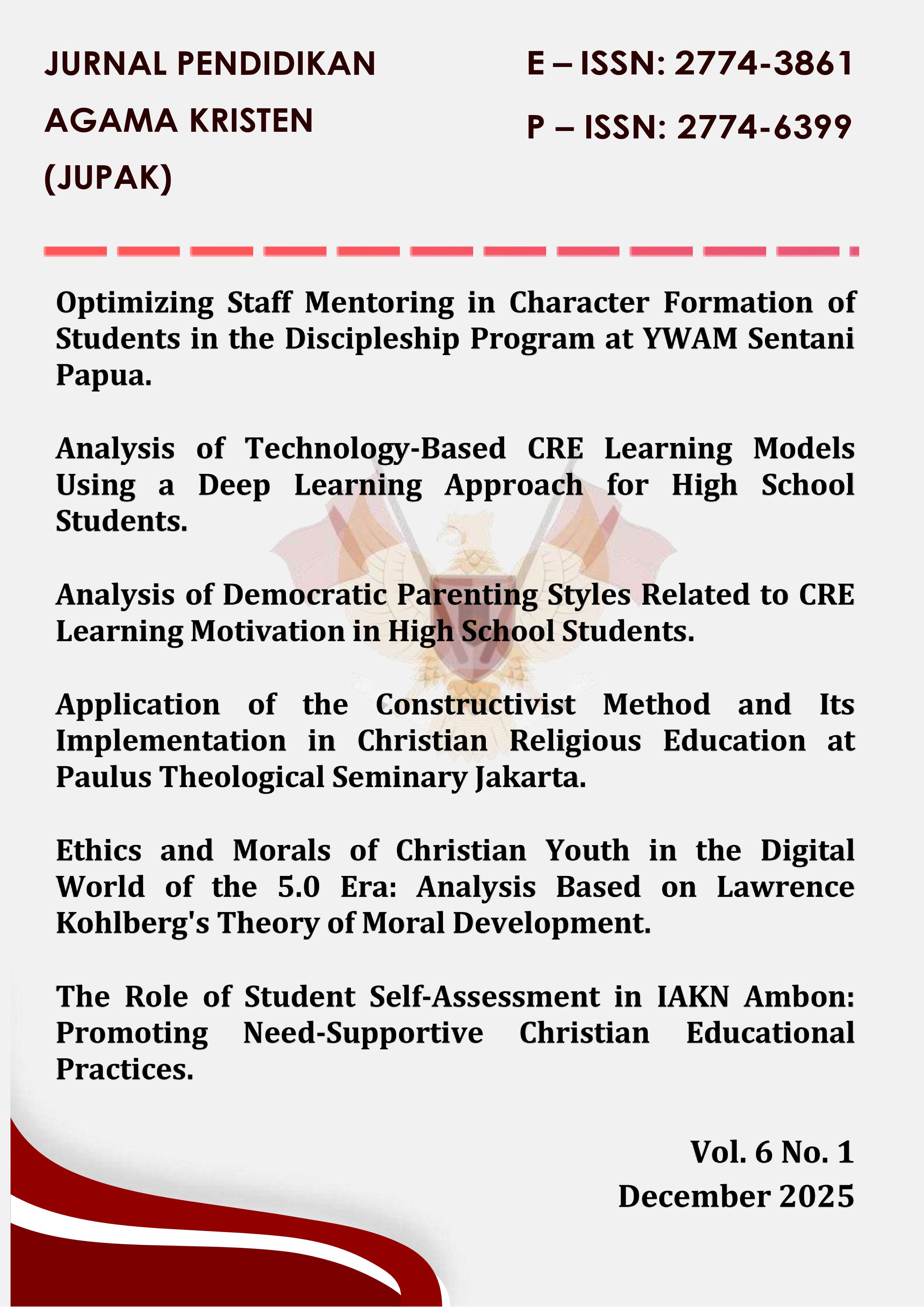
Optimizing Staff Mentoring in Character Formation of Students in the Discipleship Program at YWAM Sentani Papua
 DOI:
DOI:
https://doi.org/10.52489/jupak.v6i1.229
Keywords:
character education, discipleship, faith-based, moral development, YWAM SentaniAbstract
Character education is an important aspect in forming a young generation that is not only academically superior, but also has integrity and strong moral values. YWAM (Youth With A Mission) Sentani Papua is one of the educational institutions that integrates academic and spiritual learning through a discipleship program. However, the success of this program is highly dependent on the quality of staff mentoring for students. This study aims to examine how staff mentoring can be optimized in the formation of student character, as well as identify the challenges faced and strategies for increasing the capacity of mentors. The data shows that most staff do not have specific training in character education, which has an impact on the effectiveness of discipleship. Therefore, ongoing training and parental involvement are needed to support the holistic character formation process. Routine evaluation of program implementation is also needed so that it can be continuously improved. This study is expected to contribute to the development of character education in a faith-based educational environment
References
Bandura, A. (1997). Self-efficacy: The exercise of control. New York: Freeman.
Berkowitz, M. W., & Bier, M. C. (2005). What works in character education: A research-driven guide for educators. Washington, DC: Character Education Partnership.
Deci, E. L., & Ryan, R. M. (2000). The “what” and “why” of goal pursuits: Human needs and the self-determination of behavior. Psychological Inquiry, 11(4), 227–268.
Epstein, J. L. (2011). School, family, and community partnerships: Preparing educators and improving schools (2nd ed.). New York: Routledge.
Kementerian Pendidikan dan Kebudayaan Republik Indonesia. (2022). Laporan Tahunan Pendidikan Karakter di Indonesia. Jakarta: Kemdikbud.
Lickona, T. (1996). Eleven principles of effective character education. Journal of Moral Education, 25(1), 93–100.
Lickona, T. (2004). Character matters: How to help our children develop good judgment, integrity, and other essential virtues. New York: Touchstone / Simon & Schuster.
Livingstone, S., & Helsper, E. (2007). Gradations in digital inclusion: Children, young people and the digital divide. New Media & Society, 9(4), 671–696.
Narvaez, D. (2006). Integrative ethical education. In M. Killen & J. Smetana (Eds.), Handbook of moral development (pp. 703–733). Mahwah, NJ: Lawrence Erlbaum.
Narvaez, D., & Lapsley, D. K. (2008). Teaching moral character: Two alternatives for teacher education. Teacher Educator, 43(2), 156–172.
Narvaez, D., & Lapsley, D. K. (2009). Moral identity, moral functioning, and the development of moral character. Psychology of learning and motivation, 50, 237-274.
Noddings, N. (2013). Caring: A relational approach to ethics and moral education (2nd ed.). Berkeley: University of California Press.
Nucci, L. & Narvaez, D. (Eds.). (2008). Handbook of Moral and Character Education. New York: Routledge
Vygotsky, L. S. (1978). Mind in Society: The Development of Higher Psychological Processes. Cambridge, MA: Harvard University Press.
Sugiono, S. (2013). Metode Penelitian Kualitatif. In Bandung: Alfabeta. Alfabeta. https://scholar.google.com/scholar?cluster=18173409321155368440
Suyanto, S., & Djihad, H. (2011). Desain pendidikan karakter: Konsepsi dan aplikasinya dalam lembaga pendidikan. Yogyakarta: Multi Pressindo.
Tilaar, H. A. R. (2012). Pendidikan, kebudayaan, dan masyarakat madani Indonesia. Jakarta: Grasindo.
Trilling, B., & Fadel, C. (2009). 21st century skills: Learning for life in our times. San Francisco: Jossey-Bass.
Downloads
Published
How to Cite
Issue
Section
License
Copyright (c) 2025 Jurnal Pendidikan Agama Kristen (JUPAK)

This work is licensed under a Creative Commons Attribution-ShareAlike 4.0 International License.


MEMBER OF

ARTICLE TEMPLATE

RECOMMENDED TOOL

STATCOUNTER AND FLAG COUNTER
SIMILARITY CHECKER

Group WhatsApp

USER
TERAKREDITASI PERINGKAT 3

