
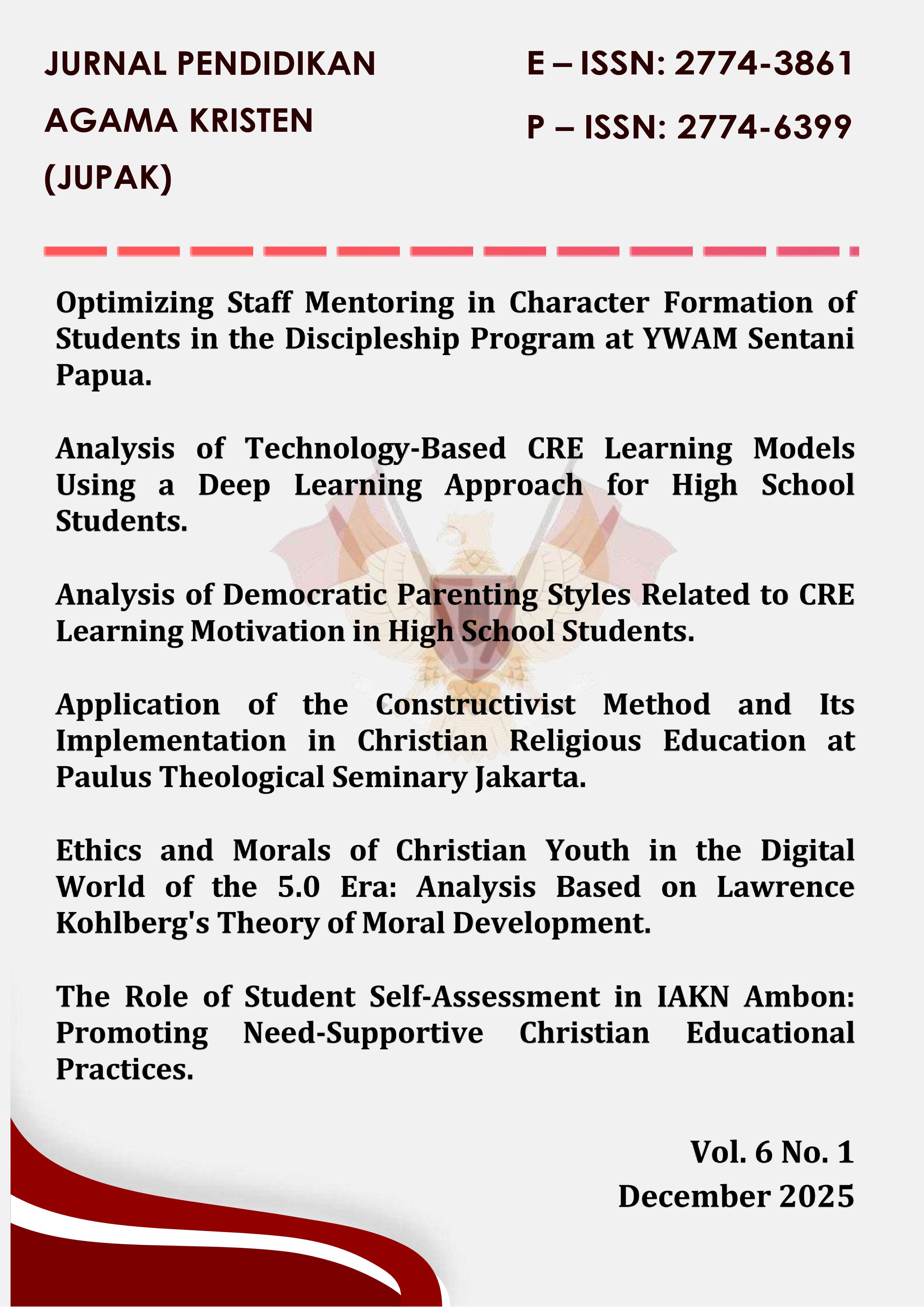
The Role of Student Self-Assessment in IAKN Ambon: Promoting Need-Supportive Christian Educational Practices
 DOI:
DOI:
https://doi.org/10.52489/jupak.v6i1.262
Keywords:
christian educational, self-supportive, students self-assessment, IAKN AmbonAbstract
Promoting sustained academic engagement among university students remains a persistent and complex challenge. Alarmingly, many higher education institutions continue to report low levels of student involvement, particularly in areas requiring integration competence and awareness of equality issues. In response to this phenomenon, the present study explores student self-assessment (SSA) as a pedagogical instrument to strengthen the connection between need-supportive teaching and desired learning outcomes. Specifically, the study proposes the incorporation of SSA into routine teaching evaluation practices as a means to enhance student understanding, foster autonomy, and promote inclusive learning environments. The primary objective of this study research was to examine the impact of SSA on students’ academic performance within the context of a "Christian Education" (PAK). To achieve this, a one-group pre-post experimental design was employed, complemented by correlational analysis to assess the relationship between SSA practices and academic achievement. Data were collected using a series of standardized academic tests and an adapted SSA questionnaire designed to measure students' perceptions and engagement in the self-assessment process. The findings reveal that regular engagement in self-assessment significantly mediates the relationship between externally managed instruction and students’ independent academic achievement. Notably, the integration of SSA was associated with enhanced student engagement and improved academic performance, even after controlling for potential confounding variables. These results suggest that SSA not only functions as a reflective practice but also serves as a behavioural mechanism through which need-supportive teaching exerts its influence on student outcomes. Overall, this study contributes to the growing body of literature on learner-centered pedagogy by demonstrating the empirical value of SSA in fostering student autonomy, engagement, and performance. The implications underscore the importance of embedding SSA into institutional teaching evaluations and highlight avenues for future research on its long-term effects across various disciplines.
References
Aelterman, N., Vansteenkiste, M., van Keer, H., De Meyer, J., Van den Berghe, L., & Haerens, L. (2013). "Development and evaluation of a training on need-supportive teaching in physical education: Qualitative and quantitative findings" dan diterbitkan di Teaching and Teacher Education, Volume 29, halaman 64–75. https://doi.org/10.1016/j.tate.2012.09.001
Andrade, H. (2019). "A critical review of research on student self-assessment" dan diterbitkan di Frontiers in Education, Volume 4, artikel 87. https://doi.org/10.3389/feduc.2019.00087
Bayrak, F. (2022). "Investigation of the web-based self-assessment system based on assessment analytics in terms of perceived self-intervention" dan diterbitkan di Technology, Knowledge and Learning, Volume 27, Issue 3, halaman 639–662. https://doi.org/10.1007/s10758-021-09511-8
Brown, G. T. L., Andrade, H. L., & Chen, F. (2015). "Accuracy in student self-assessment: Directions and cautions for research" dan diterbitkan di Assessment in Education: Principles, Policy & Practice, Volume 22, Issue 4, halaman 444–457. https://doi.org/10.1080/0969594X.2014.996523
Burns, E. C., Martin, A. J., Collie, R. J., & Mainhard, T. (2021). "Perceived classroom disruption undermines the positive educational effects of perceived need-supportive teaching in science" dan diterbitkan di Learning and Instruction, Volume 75, artikel 101498. https://doi.org/10.1016/j.learninstruc.2021.101498
Ciani, K. D., Middleton, M. J., Summers, J. J., & Sheldon, K. M. (2010). Buffering against performance classroom goal structures: The importance of autonomy support and classroom community. Contemporary Educational Psychology, 35(2), 88–99. https://doi.org/10.1016/j.cedpsych.2009.11.001
Dann, R. (2014). Assessment as learning: Blurring the boundaries of assessment and learning for theory, policy and practice. Assessment in Education: Principles, Policy & Practice, 21(2), 149–166. https://doi.org/10.1080/0969594X.2014.898128
Guay, F., Ratelle, C. F., & Chanal, J. (2008). Optimal learning in optimal contexts: The role of self-determination in education. Canadian Psychology, 49(3), 233–240. https://psycnet.apa.org/buy/2008-10897-009
Panadero, E., Andrade, H., & Brookhart, S. (2018). Fusing self-regulated learning and formative assessment: A roadmap of where we are, how we got here, and where we are going. Australian Educational Researcher, 45(1), 13–31. https://doi.org/10.1007/s13384-018-0258-y
Ryan, R. M., & Deci, E. L. (2017). Self-Determination Theory: Basic Psychological Needs in Motivation, Development, and Wellness. Guilford Press. https://doi.org/10.7202/1041847ar
Yan, Z., & Brown, G. T. L. (2017). A cyclical self-assessment process: Towards a model of how students engage in self-assessment. Assessment & Evaluation in Higher Education, 42(8), 1247–1262. https://doi.org/10.1080/02602938.2016.1260091
Zhou, M., Panadero, E., & Järvelä, S. (2022). Scaffolding self-regulated learning through assessment: A review of the literature. Educational Psychology Review, 34, 611–637. https://doi.org/10.1007/978-3-319-39211-0_18
Downloads
Published
How to Cite
Issue
Section
License
Copyright (c) 2025 Jurnal Pendidikan Agama Kristen (JUPAK)

This work is licensed under a Creative Commons Attribution-ShareAlike 4.0 International License.


MEMBER OF

ARTICLE TEMPLATE

RECOMMENDED TOOL

STATCOUNTER AND FLAG COUNTER
SIMILARITY CHECKER

Group WhatsApp

USER
TERAKREDITASI PERINGKAT 3

