
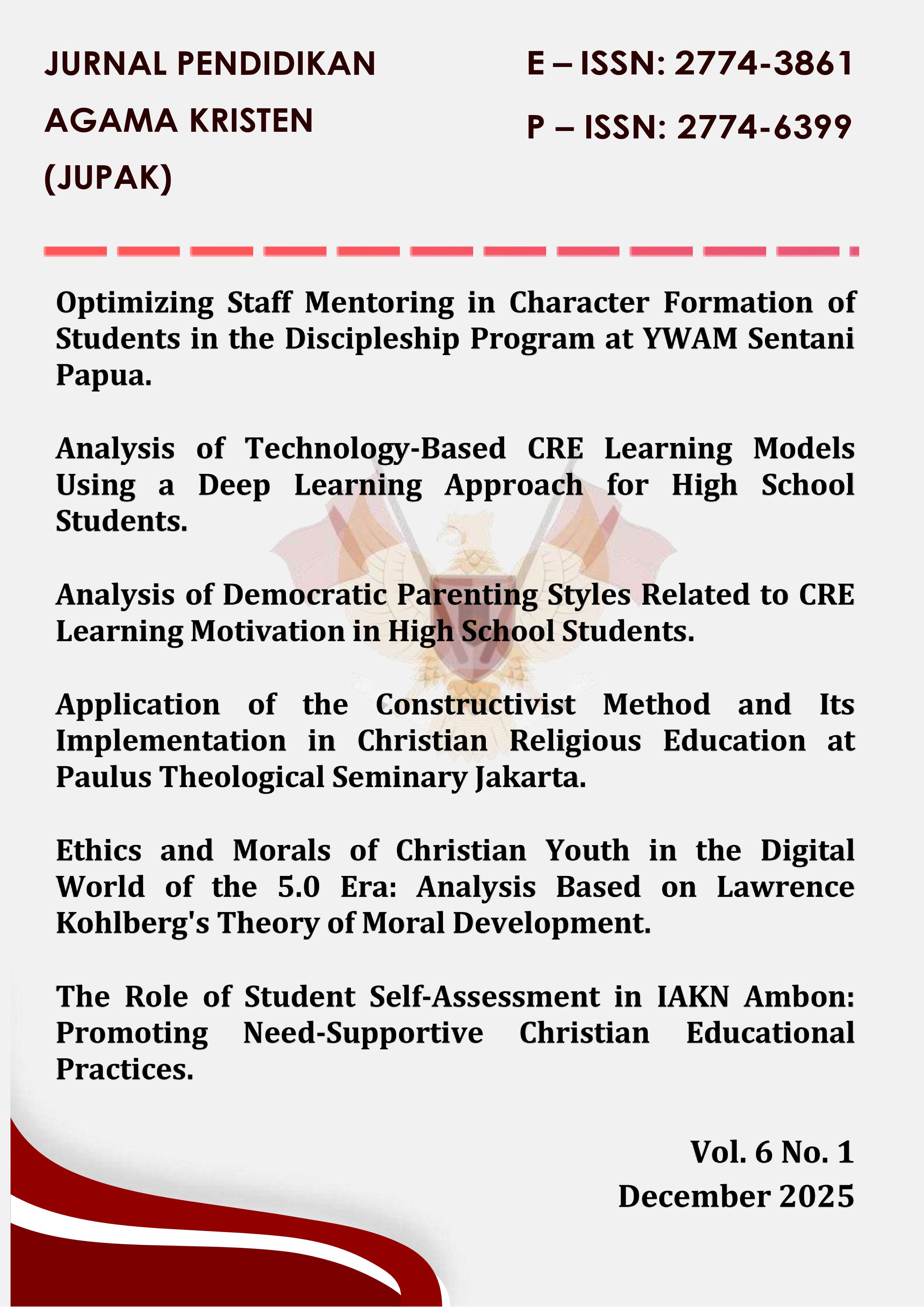
Application of the Constructivist Method and Its Implementation in Christian Religious Education at Paulus Theological Seminary Jakarta
 DOI:
DOI:
https://doi.org/10.52489/jupak.v6i1.290
Keywords:
Constructivism, Christian Religious Education, Theological Education, STT Paulus Jakarta, PedagogyAbstract
This study examines the application of constructivist pedagogy within Christian Religious Education at Sekolah Tinggi Teologi Paulus Jakarta. Constructivism rooted in the work of Jean Piaget and Lev Vygotsky posits that knowledge is actively built by learners through experience, reflection, and social interaction rather than passively transferred from instructors. In theological education, this shift reframes lecturers as facilitators who scaffold students’ personal and communal engagement with Scripture and Christian doctrine. Employing a qualitative descriptive design that integrates literature review, non-participant observation, and semi-structured interviews with lecturers and students, the study finds that constructivist practices at STT Paulus Jakarta promote higher-order thinking, contextual biblical interpretation, and collaborative learning. Notwithstanding these benefits, challenges persist in lecturer readiness, student self-regulation, and resource availability. The paper argues that constructivism is both relevant and effective for Christian education, provided it is supported by institutional commitment to professional development and pedagogical innovation.
References
Biggs, J., & Tang, C. (2011). Teaching For Quality Learning At University. McGraw-Hill Education. https://books.google.co.id/books?id=XhjRBrDAESkC
Biggs, J., Tang, C., & Kennedy, G. (2022). Teaching for quality learning at university 5e. McGraw-hill education (UK).
Bruner, J. S. (1977). The Process of Education: Revised Edition. Harvard University Press.
https://books.google.co.id/books?id=Iaq5R8vPujAC
Dockery, D. S. (1995). The Challenge of Postmodernism: An Evangelical Engagement. Victor Books. https://books.google.co.id/books?id=JXtXAAAACAAJ
Groome, T. (1998). Sharing faith: A comprehensive approach to religious education and pastoral ministry: The way of shared praxis. Wipf and Stock Publishers.
Miles, M. B., Huberman, A. M., & Saldana, J. (2014). Qualitative data analysis: A methods sourcebook. SAGE Publication.
Moleong, L. J. (2012). Metodelogi Penelitian Kualitatif (Revisi). PT. Remaja Rosdakarya.
Palmer, P. J. (2017). The courage to teach guide for reflection and renewal. John Wiley & Sons.
Piaget, J., Piercy, M., & Berlyne, D. E. (2001). The Psychology of Intelligence. Routledge. https://books.google.co.id/books?id=jJZ7aWY4tIcC
Slavin, R. E. (1997). Educational psychology: theory and practice. Allyn and Bacon.
Vygotsky, L. S. (1978). Mind in society: The development of higher psychological processes (Vol. 86). Harvard university press.
Downloads
Published
How to Cite
Issue
Section
License
Copyright (c) 2025 Jurnal Pendidikan Agama Kristen (JUPAK)

This work is licensed under a Creative Commons Attribution-ShareAlike 4.0 International License.


MEMBER OF

ARTICLE TEMPLATE

RECOMMENDED TOOL

STATCOUNTER AND FLAG COUNTER
SIMILARITY CHECKER

Group WhatsApp

USER
TERAKREDITASI PERINGKAT 3

