
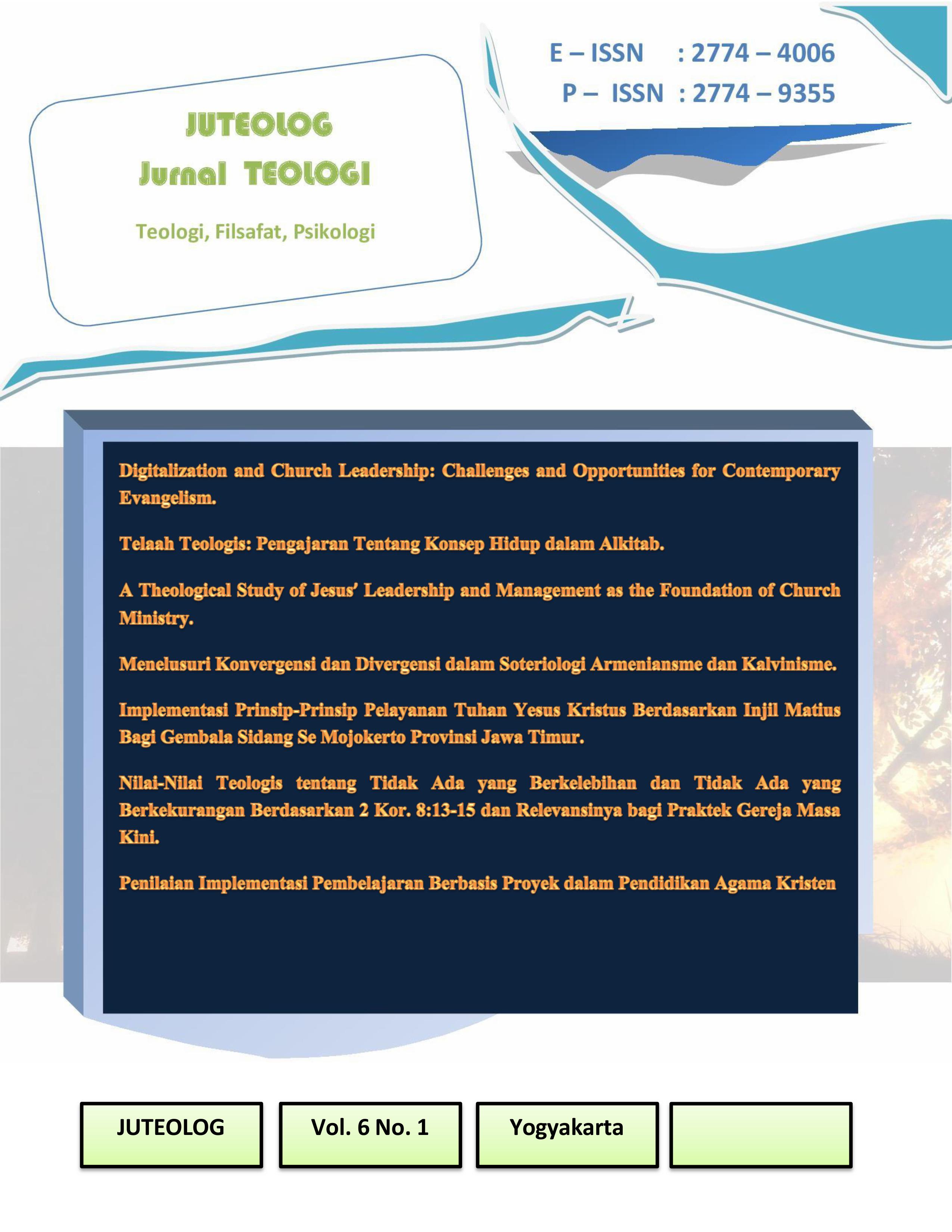
A Theological Study of Jesus’ Leadership and Management as the Foundation of Church Ministry
 DOI:
DOI:
https://doi.org/10.52489/juteolog.v6i1.247
Keywords:
Jesus’ Leadership, Management, Church Ministry, Theological Leadership, Practical TheologyAbstract
This theological study explores the nature and implementation of Jesus’ leadership and management as a foundational paradigm for church ministry. Utilizing a phenomenological methodology within a naturalistic paradigm and grounded in a qualitative research approach, data were gathered through observation, in-depth interviews, and comprehensive literature analysis. The findings reveal a significant disparity in the understanding and application of Jesus’ leadership and management principles within ecclesial contexts. This discrepancy is primarily attributed to four interrelated factors: (1) insufficient comprehension of the foundational concepts of Jesus’ leadership and management, (2) a lack of clarity regarding their intended purpose within ministry,(3) weak strategic alignment with Jesus’ leadership model, and(4) the absence of Christlike character in the exercise of leadership roles within the church. Drawing upon theological frameworks and empirical insights, the study proposes a contextualized model for integrating the leadership and management of Jesus as a core foundation for effective and faithful church ministry. The research outcomes offer practical implications for local congregations in Indonesia and serve as a reference point for future theological and pastoral scholarship. All reflections and recommendations are ultimately directed toward the glorification of God.
References
Anthony, N. R., & Govindarajan, V. (2011). Sistem Pengendalian Manajemen (Edisi ke-12). Karisma.
Banks, R., & Ledbetter, B. M. (2004). Reviewing Leadership: A Christian Evaluation of Current Approaches. Baker Academic.
Barentsen, J. (2011). Emerging Leadership in the Pauline Mission: A Social Identity Perspective on Local Leadership Development in Corinth and Ephesus. Wipf & Stock.
Barna, G. (2009). Leaders on Leadership. Gandum Mas.
Barna Group. (2020). The State of the Church 2020. Barna Research.
Barth, K. (1958). Church Dogmatics IV/3. T&T Clark.
Blackaby, H., & Blackaby, R. (2011). Spiritual Leadership: Moving People on to God's Agenda. B&H Publishing.
Bosch, D. J. (1991). Transforming Mission: Paradigm Shifts in Theology of Mission. Orbis Books.
Bosch, D. J. (2011). Transforming Mission: Paradigm Shifts in Theology of Mission. Orbis Books.
Creswell, J. W. (2013). Qualitative Inquiry and Research Design: Choosing Among Five Approaches (3rd ed.). SAGE Publications.
Durkheim, E. (2001). The Elementary Forms of Religious Life. Oxford University Press.
Frost, M., & Hirsch, A. (2013). The Shaping of Things to Come: Innovation and Mission for the 21st-Century Church. Baker Books.
Greenleaf, R. K. (2002). Servant Leadership: A Journey into the Nature of Legitimate Power and Greatness. Paulist Press.
Hammond, J. (2003). Kepemimpinan yang Sukses. Metanoia.
Hasibuan, S. A. (2005). Pengertian Pemimpin dan Kepemimpinan dalam Organisasi. Makalah.
Hendrawan, Y. (2009). Tesis Pascasarjana. STT The Way.
Hotagaol, A. (2010). Memimpin Seperti Yesus: Bisakah? Gandum Mas.
Joice, M. (2002). Pemimpin yang Sedang Dibentuk. Imanuel.
Keller, T. (2012). Every Good Endeavor: Connecting Your Work to God’s Work. Penguin.
Kittel, G., & Friedrich, G. (1985). Theological Dictionary of the New Testament (Vol. 3). Eerdmans.
Lasut, J. C. (2015). Kepemimpinan Gereja. Bahan Presentasi Kuliah.
Lumintang, I. S. (2010). Keunikan Teologi Kristen di Tengah Kepalsuan. YPPII.
Malphurs, A. (2003). Being Leaders: The Nature of Authentic Christian Leadership. Baker Books.
Martomo. (2014). Disertasi Program Doktoral. Institut Injili Indonesia, Batu Malang.
Maxwell, J. C. (1995). Mengembangkan Kepemimpinan di Dalam Diri Anda. Binarupa Aksara.
Maxwell, J. C. (2002). 21 Menit Paling Bermakna dalam Hari-hari Pemimpin Sejati. Interaksara.
Maxwell, J. C. (2004). 21 Hukum Kepemimpinan Sejati. Interaksara.
Middleton, J. R. (2005). The Liberating Image: The Imago Dei in Genesis 1. Brazos Press.
Moleong, L. J. (2019). Metodologi Penelitian Kualitatif (Edisi Revisi). Remaja Rosdakarya.
Moltmann, J. (1985). God in Creation: A New Theology of Creation and the Spirit of God. SCM Press.
Octavianus, P. (2007). Manajemen dan Kepemimpinan Menurut Wahyu Allah. YPPII-PGM.
Plantinga, A. (2002). Warranted Christian Belief. Oxford University Press.
Rice, H. (1998). Manajemen Umat: The Pastor as Spiritual Guide. YKH Bandung.
Rush, M. (2013). Manajemen Menurut Pandangan Alkitab. Gandum Mas.
Sanders, J. O. (2007). Spiritual Leadership: Principles of Excellence for Every Believer. Moody Publishers.
Siswanto, H. B. (2012). Pengantar Manajemen. Bumi Aksara.
Spradley, J. P. (1980). Participant Observation. Holt, Rinehart and Winston.
Susabda, Y. B. (2006). Prinsip-prinsip dalam Administrasi Gereja. Gandum Mas.
Tozer, A. W. (2011). The Knowledge of the Holy. HarperOne.
Tomatala, Y. (2003). Manajemen: Pendekatan PASTI. YT Leadership Foundation.
Tomatala, Y. (2011). Penatalayanan Gereja yang Efektif di Dunia Modern. PGM.
Torang, S. (2013). Organisasi dan Manajemen: Perilaku, Struktur, Budaya, Perubahan Organisasi. Alfabeta.
Van Gelder, C. (2007). The Ministry of the Missional Church: A Community Led by the Spirit. Baker Books.
Van Gelder, C., & Zscheile, D. J. (2011). The Missional Church in Perspective: Mapping Trends and Shaping the Conversation. Baker Academic.
Vanhoozer, K. J. (2015). The Pastor as Public Theologian: Reclaiming a Lost Vision. Baker Academic.
Walz, E. (2008). Bagaimana Mengelola Gereja Anda? BPK Gunung Mulia.
Weber, M. (1978). Economy and Society: An Outline of Interpretive Sociology. University of California Press.
Windarwati, M. T., Sirait, J. R., Istinatun, H. N., Parulian, T., & Emeliana, E. (2021). Relevansi Transformational Leadership Di Lembaga Pendidikan Kristen. Jurnal Pendidikan Agama Kristen (JUPAK), 2(1), 1–12. https://doi.org/10.52489/jupak.v2i1.40
Wright, C. J. H. (2010). The Mission of God's People: A Biblical Theology of the Church’s Mission. Zondervan.
Wright, N. T. (2010). After You Believe: Why Christian Character Matters. HarperOne.
Wright, N. T. (2012). How God Became King: The Forgotten Story of the Gospels. HarperOne.
Downloads
Published
How to Cite
Issue
Section
License
Copyright (c) 2025 Jurnal Teologi (JUTEOLOG)

This work is licensed under a Creative Commons Attribution-ShareAlike 4.0 International License.


TERAKREDITASI PERINGKAT 4

MEMBER OF

ARTICLE TEMPLATE

RECOMMENDED TOOL

STATCOUNTER AND FLAG COUNTER
SIMILARITY CHECKER

Group WhatsApp

